🇬🇭 Ghana · Ga · Akan · 6 min read
Why the Sun and Moon Live in the Sky
Hospitality and knowing your limits
Cultural Background
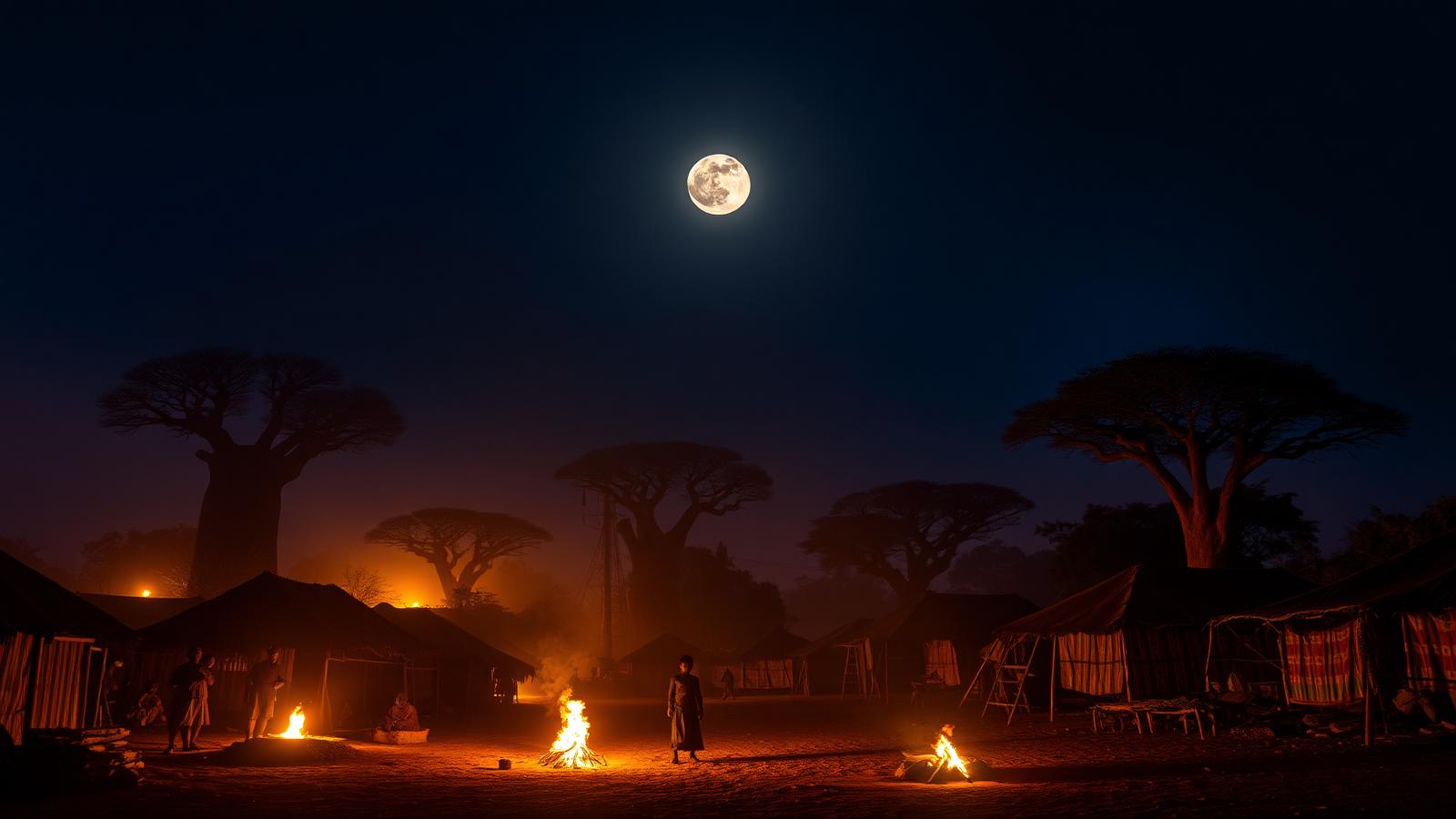
Among the Ga and Akan peoples of coastal Ghana, this creation tale offers a playful explanation for why the sun and moon are found in the sky rather than living among people on earth, joining a wide family of African pourquoi tales that explain natural phenomena through stories of friendship, hospitality, and consequence. The tale carries real cultural weight around the practice of hospitality, which is treated with great seriousness in Ghanaian tradition — a guest is honored generously, yet the story gently teaches that generosity without foresight can overwhelm even the most well-meaning host. Water's arrival with its vast, ever-growing family also reflects the coastal and riverine geography of Ga and Akan life, where the Gulf of Guinea and its network of lagoons and rivers were both a source of tremendous abundance and a genuine, ever-present threat of flooding.
The Moonlight Story
Long ago, before people looked up at the sky and saw the sun and the moon fixed forever in their places, Sun and Moon lived on the earth in a fine, spacious house built of mud brick and thatch, much like any other prosperous family's home. They were the best of friends with Water, who lived some distance away near the mouth of the great river, though the two friends had never actually visited each other's houses, since Water always claimed it was too difficult to travel so far from home.
One day, Sun said to Moon, 'It troubles me that Water has never once come to see our house, though we have visited every other friend we have. Let us invite Water properly, with a formal invitation, so that Water can no longer make excuses.'
Moon agreed, and together they sent a messenger, the swift dragonfly, to carry their invitation to Water. 'Come and see our new house,' the invitation said, 'and bring your family with you, as is only proper for such an important guest.'
Water received the invitation and sent back a reply through the dragonfly. 'I would be glad to visit,' Water said, 'but I must warn you, my family is very large, and I fear we may not all fit comfortably inside your house. Are you certain you wish for all of us to come?'
Sun and Moon, eager and a little proud of their fine new home, laughed at this warning. 'Our house is large and welcoming,' Sun replied. 'Surely there is room enough for our dear friend Water and whoever comes along.'
So on the appointed day, Water began to arrive. First came a small trickle, no wider than a stream, flowing gently in through the front door and settling on the floor of the house. Sun and Moon greeted this trickle warmly. 'Welcome, Water! Come in, come in!'
But behind the trickle came more water, and more, rising steadily around their ankles, and with the water came fish of every size, darting between the legs of the furniture, and then crabs scuttling sideways along the walls, and then eels sliding beneath the mats on the floor.
'Come in, come in,' Sun and Moon called again, a little less certainly now, as the water rose past their knees.
Still more of Water's family arrived — turtles paddling through the doorway, frogs leaping onto the windowsills, and then, with a great deal of splashing and commotion, several enormous crocodiles slid in through the widened doorway, their long snouts nudging aside the household pots and baskets. The water in the house had now risen to Sun and Moon's waists.
'Water, my friend,' Sun called out nervously over the rising din, 'perhaps this is enough of your family for one visit!'
But Water, from somewhere out in the yard, called back cheerfully, 'I did warn you, dear friends, that my family is very large. There is still my grandmother, the deep river, and my many cousins, the streams and lagoons, and my great-uncles, the crashing waves of the sea, all eager to greet you properly!'
And sure enough, more water came pouring through every window and doorway, rising and rising, until it reached Sun and Moon's shoulders, then their chins, filling the house from floor to roof beam with churning, living water, alive with fish and crocodiles and eels and the endless motion of the tide.
Sun and Moon, gasping and dripping, realized there was only one place left to go. They scrambled up onto the roof of their own house, but even there the water continued to rise beneath them, lapping hungrily at the thatch.
'We must go higher still!' cried Moon, and so the two friends leapt from the roof of their flooding house up into the open sky above, climbing higher and higher until they found themselves floating safely above all the rising water, farther from the ground than they had ever been in their lives.
From up in the sky, Sun and Moon looked down and saw their fine house completely submerged, water pouring from every window, Water's enormous family filling every room and spilling out across the yard and beyond, turning the whole valley into a great gleaming lake.
'We cannot go back down there now,' said Sun, looking at the flood below with a mixture of dismay and grudging admiration. 'Water's family is simply too large for any house that exists on earth.'
'Then we shall have to stay here,' said Moon, settling into the vast, comfortable darkness of the sky, 'where there is room enough for everyone, and no risk of flooding at all.'
And so Sun and Moon made their permanent home in the sky from that day onward, taking turns crossing the great open expanse above the earth, never again inviting a friend to visit without first asking exactly how large that friend's family truly was. And that is why, to this day, the Ga and Akan people say, the sun rules the daytime sky and the moon rules the night, both of them forever a comfortable, respectful distance from the boundless, ever-growing family of Water below.
Moral Lessons
What the Story Teaches
- For children
- It is kind to be generous and welcoming, but it is also wise to ask questions before making a big promise you cannot take back.
- For adults
- Generosity without foresight can overwhelm you. Real hospitality includes honest planning, not just an open door.
- For leadership
- A leader who commits resources or promises without first understanding the true scale of a request may find themselves pushed out of their own house, so to speak.
- For business
- Before agreeing to a large partnership or contract, ask enough questions to understand its full scope — enthusiasm is not the same as preparation.
- For family
- Welcoming extended family or guests with generosity is a beautiful value, but households benefit from honest conversations about capacity beforehand.
- For community
- A community's resources, like a small house facing a flood, can be overwhelmed by good intentions poorly planned; wisdom means pairing generosity with foresight.
Discussion Questions
For the Family or Classroom
- Why did Sun and Moon insist that Water bring the whole family, even after being warned?
- What does Water's growing family represent — is it a flaw or simply its nature?
- Could Sun and Moon have avoided losing their house? What might they have done differently?
- Why do you think the story ends with Sun and Moon happy in the sky rather than angry about losing their home?
- How does this story explain something in nature while also teaching a practical lesson?
- Have you ever underestimated how much a generous offer would actually cost or require?
Related Proverbs
"If you invite the river, prepare for the fish."
"A small house cannot hold a great family's joy."
"The wise host asks the size of the appetite before laying the table."
Characters
Sun
Co-host of the ill-fated visit
Proud, welcoming, ultimately adaptable
Symbolism: Daylight and the warmth of hospitality taken to its limit
Moon
Co-host and Sun's companion
Agreeable, calm, quick to find a new solution
Symbolism: Steady companionship and graceful adjustment to change
Water
The overwhelming guest
Cheerful, honest about its own nature, unstoppable once in motion
Symbolism: Abundance and nature's forces, generous but impossible to fully contain
Vocabulary
Pourquoi tale
poor-KWAH tale · Folklore studies term, French origin
A traditional story that explains why something in nature exists as it does
Lagoon
luh-GOON · Coastal Ghanaian geography
A shallow body of water separated from the sea by a sandbar or reef, common along Ghana's coast
Thatch
thach · Traditional West African architecture
A roofing material made of dried plant stalks such as straw or palm leaves
Watch
Animated story film coming soon.
Listen
Narrated audio coming soon.
Music
McEncomium song adaptation coming soon.
Teacher Resources
For Classrooms and Homes
Download the full parable as a printable PDF — story, cultural background, moral lessons, discussion questions, proverbs, characters, and vocabulary, all in one handout for the classroom or family read-aloud.
Join the conversation
Village Square
Share your thoughts on this parable, ask questions, and connect with others exploring African stories and wisdom.
Village Voices
What villagers say about "Why the Sun and Moon Live in the Sky"
Loading comments…