🇰🇪 Kenya · Maasai · 7 min read
The Maasai Boy and the Stars
Patience and the slow lesson of the sky
Cultural Background
Among the Maasai of the Rift Valley, the passage from boyhood to moranhood, the warrior stage of life, is marked by rigorous training, endurance tests, and ceremonies that unfold over years, not days. Elders play a central role in this process, using patience, silence, and carefully chosen tasks rather than lectures to teach young men what cannot be rushed. The night sky itself holds deep significance in Maasai cosmology; the stars, the moon, and Enkai, the sky god associated with both the blessing of rain and the discipline of drought, are woven into stories that teach humility before forces greater than any single person's will. Sending a boy to spend a night alone under the stars, as happens in this tale, reflects an actual tradition of solitary trials used in many pastoralist societies of East Africa to test a young person's courage and self-command before greater responsibility is granted. The lesson is rarely delivered as a direct instruction; instead, as with much of Maasai oral teaching, the elder trusts that the experience itself, given enough patient stillness, will teach what words cannot.
The Moonlight Story
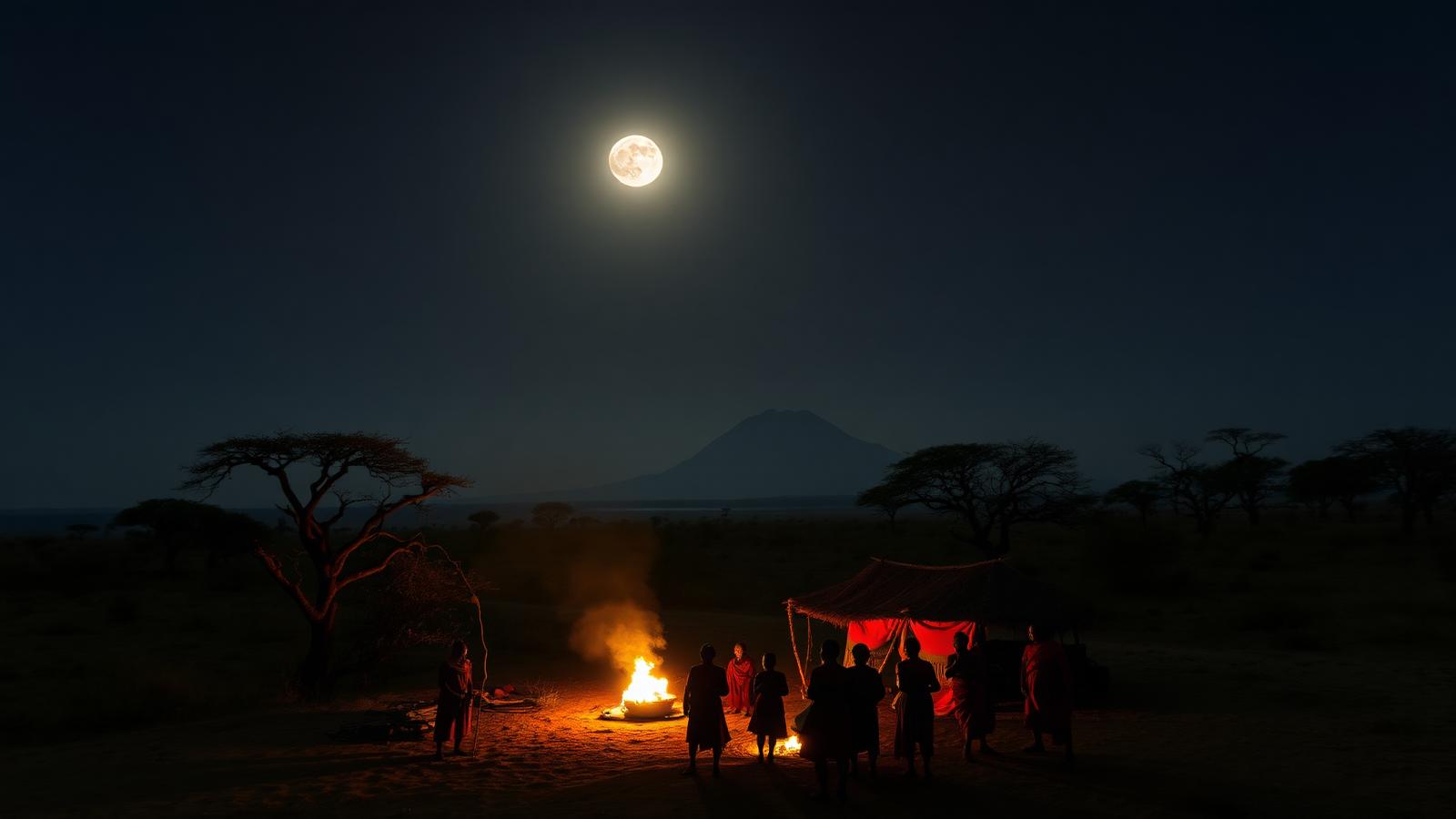
In a manyatta on the wide plains beneath the Ngong Hills lived a boy named Lekishon, who had counted twelve rainy seasons and believed, with the fierce certainty only a twelve-year-old can hold, that he was more than ready to become a moran, a warrior of his people. He had watched the older boys practice with their spears, admired the way they walked with straight backs and proud eyes, and he could not understand why his grandfather, Ole Karia, kept telling him, 'Not yet, Lekishon. Not yet.'
'I can run faster than Sironka,' Lekishon complained one evening, as the cattle settled into the boma for the night. 'I can throw a spear farther than Meoli. Why must I wait while smaller boys with less courage prepare for the warrior ceremony?'
Ole Karia, whose face carried the deep lines of eighty rainy seasons, considered his grandson for a long moment before he spoke. 'Running fast and throwing far are the easy parts of becoming a man, my grandson. They are the parts your body already knows. There is a harder part, one your body cannot teach you no matter how fast it runs.'
'What part is that, grandfather?'
'Come with me tonight, and I will show you, though I will not speak a single word of it. Tonight you will sleep outside the boma, beneath the open sky, alone, and you will count the stars until dawn. When the sun rises, you may tell me what you have learned, and then we will speak again of moranhood.'
Lekishon was thrilled. Counting stars sounded easy, even pleasant, certainly easier than the herding and fetching he did every day. He gathered his shuka around his shoulders, took his grandfather's walking stick for company, and settled onto a flat rock a short distance from the boma as the sun sank behind the hills.
At first it was exactly the adventure he had imagined. The sky above the plains, far from any fire's glow, filled slowly with more stars than he had ever properly noticed, scattered so thickly in places that they blurred into pale rivers of light. He began counting eagerly: one, two, three, ten, thirty, determined to reach some triumphant number he could report to his grandfather at dawn.
But the stars did not stay in neat rows waiting to be counted. New ones appeared as his eyes adjusted to the darkness, ones he had missed entirely at first glance. Clusters he thought he had already counted seemed, on a second look, to hold stars within stars, faint ones hiding behind brighter ones. By the time he reached what he believed was three hundred, he had lost track of where he began, and doubt crept in — had he counted that cluster near the horizon already, or only imagined he had?
The night grew cold, colder than he expected, and the wind off the plains found its way beneath his shuka no matter how tightly he wrapped it. A hyena's laugh rose somewhere in the darkness, closer than was comfortable, and Lekishon's earlier confidence shrank down to something smaller and more honest. He thought of calling out to the boma, only a short distance away, but pride kept his mouth shut, and in that silence he noticed something he had never noticed before: how loud his own frightened heartbeat sounded when there was nothing else to listen to.
He stopped counting. He simply sat, wrapped in his shuka, and watched. The stars did not hurry across the sky the way his thoughts had been hurrying all evening. They moved so slowly that if he stared at one point too intently, he could convince himself nothing was moving at all — and yet, when he looked away and returned his gaze an hour later, everything had shifted, the whole dome of the sky quietly rearranged without a single sound or announcement.
Somewhere in the deepest, coldest hour of the night, Lekishon understood, without anyone telling him, that he had been trying to conquer the sky the way he conquered a foot race — by speed, by will, by getting there first. But the sky was not a race. It moved at its own pace regardless of how badly he wanted to master it in one sitting, and the only thing his impatience had earned him was confusion and a lost count.
When dawn finally broke pink and gold over the plains, and the cattle began to stir in the boma, Lekishon walked back to his grandfather with tired eyes and empty hands.
'How many stars did you count, my grandson?' asked Ole Karia, though his eyes suggested he already guessed the answer.
'I do not know, grandfather. I lost count many times. The sky was too large and too patient for me.'
Ole Karia nodded slowly, and for the first time that Lekishon could remember, he smiled the particular smile he usually saved for the elders' council. 'That,' he said, 'is the hardest part of becoming a moran, and you have learned it in one night what takes some men many seasons to understand. A warrior's spear arm can be trained in a season, but a warrior's patience, his willingness to be small before something greater than himself, that is trained only by nights like the one you have just spent. Now you are closer to ready than you were yesterday, not because you counted the stars, but because you learned you could not.'
Lekishon never did finish counting the stars, not that night nor any night after, but from then on, when the older boys grew hasty or boastful before a hunt or a ceremony, it was often Lekishon, quiet and watchful, who reminded them that some things cannot be rushed, and that the night teaches patience to those willing to sit still long enough to be taught.
Moral Lessons
What the Story Teaches
- For children
- Some skills cannot be learned quickly, no matter how eager you are. Patience is its own kind of strength.
- For adults
- Impatience often masks a fear of sitting with uncertainty. Growth sometimes looks like doing nothing but paying close attention.
- For leadership
- A good mentor does not always explain the lesson directly. Sometimes the wisest guidance is placing someone in an experience and trusting it to teach.
- For business
- Rushing to master a skill or a market before truly understanding its scale leads to overconfidence and mistakes. Respect the size of what you are trying to learn.
- For family
- Elders often see readiness differently than the young do. Trusting that difference, even when it is frustrating, can prevent real harm.
- For community
- A community that rushes its young into responsibility without patience-building experiences risks leaders who cannot sit still with hard, slow problems.
Discussion Questions
For the Family or Classroom
- Why did Ole Karia choose silence and an experience instead of simply explaining patience to Lekishon?
- What changed in Lekishon's understanding of the sky between the beginning and end of the night?
- Why do you think losing count of the stars mattered more than any number he could have reached?
- How does fear, in this story, become a teacher rather than only an obstacle?
- What does the proverb 'Meeta enkai oltungani obo' suggest about how the Maasai see personal growth?
- Have you ever learned an important lesson through waiting rather than through being told directly?
Related Proverbs
"Meeta enkai oltungani obo."
"Enkolong'i naa nabo, nemeidim ilo."
"Osilale mengata olng'atuny."
Characters
Lekishon
The impatient herdsboy
Eager, proud, physically confident but restless
Symbolism: Youthful ambition that has not yet met humility
Ole Karia
Lekishon's grandfather and elder
Patient, wise, teaches through experience rather than instruction
Symbolism: The quiet authority of accumulated age and observation
Vocabulary
Manyatta
mahn-YAHT-tah · Maasai
A traditional Maasai settlement, often associated with warriors
Moran
moh-RAHN · Maasai
A Maasai warrior, typically a young man in a specific age-set
Shuka
SHOO-kah · Maasai / Swahili
A traditional cloth wrap worn by the Maasai
Enkai
en-KYE · Maasai
The Maasai sky god, associated with rain and providence
Watch
Animated story film coming soon.
Listen
Narrated audio coming soon.
Music
McEncomium song adaptation coming soon.
Teacher Resources
For Classrooms and Homes
Download the full parable as a printable PDF — story, cultural background, moral lessons, discussion questions, proverbs, characters, and vocabulary, all in one handout for the classroom or family read-aloud.
Join the conversation
Village Square
Share your thoughts on this parable, ask questions, and connect with others exploring African stories and wisdom.
Village Voices
What villagers say about "The Maasai Boy and the Stars"
Loading comments…