🇿🇦 South Africa · Xhosa · 7 min read
The Girl Who Married the River
Sacrifice and the gifts of the ancestors
Cultural Background
Among the amaXhosa, rivers are not merely water but the dwelling places of the abantu bomlambo, the river people, and of ancestral spirits who move between the world of the living and the world beneath the water. Stories of a girl who enters the river and returns transformed echo the initiation journeys undergone by amagqirha, diviners called by the ancestors through dreams and illness near water. Beadwork, too, carries deep meaning in Xhosa culture — its colours and patterns are a language of status, courtship and memory, so a gift of beads from a grandmother is never a small thing; it is inheritance, protection and blessing woven into thread.
The Moonlight Story
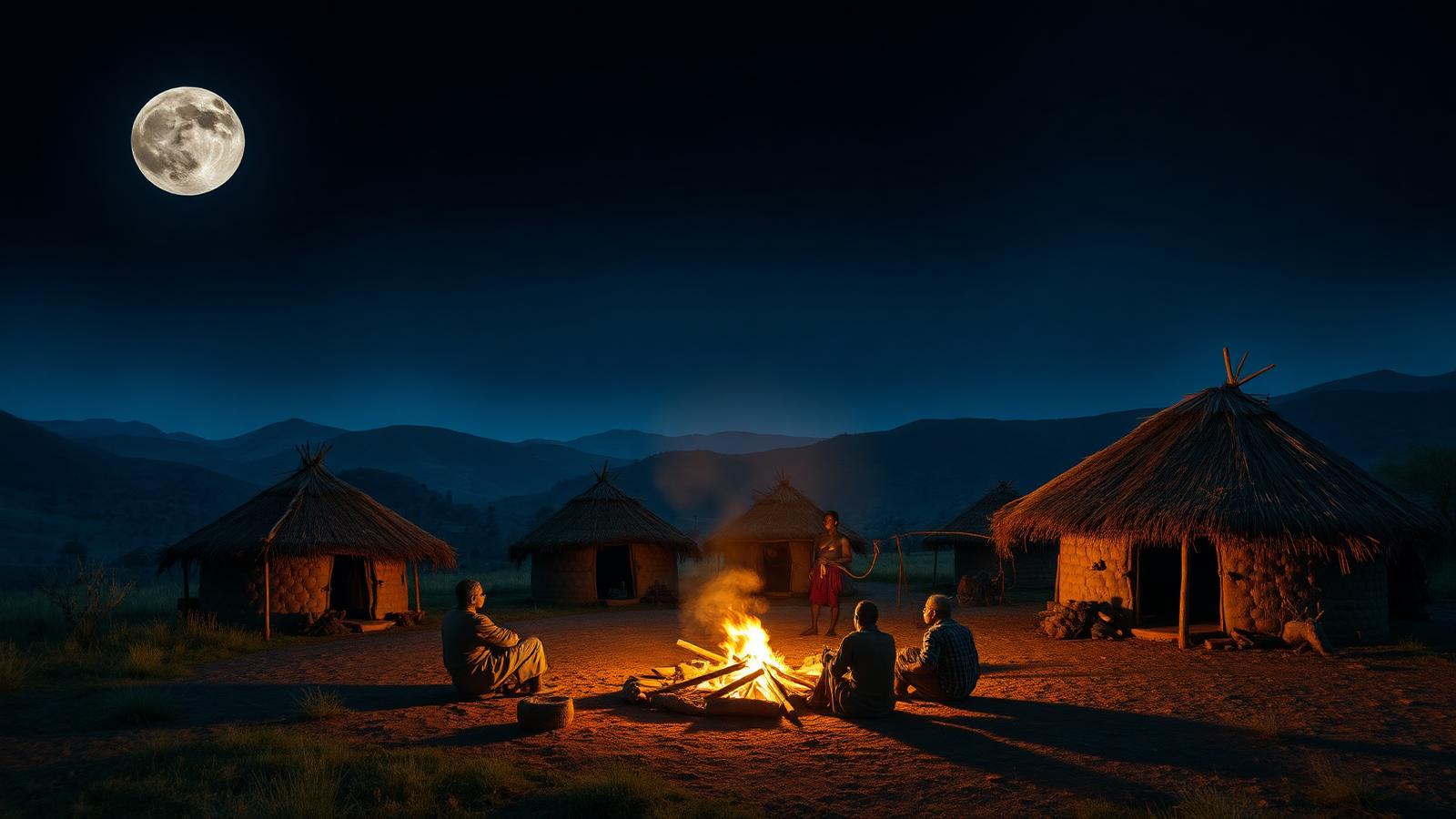
There was a year, the old women say, when the rains simply forgot the way to the Eastern Cape. The mielie fields cracked into brown scales. The cattle grew thin as fence posts. And the river that had always sung past the village of Zanele's family — the river the elders called Mama Nolwazi, Mother of Knowledge — shrank to a trickle of mud between white stones.
Zanele was thirteen that year, old enough to carry water on her head without spilling it, and old enough to see the fear behind her mother's eyes when she looked at the empty clay pots lined against the hut wall. The village council had tried everything. They had slaughtered a goat and poured its blood into the riverbed. They had sent the strongest young men to walk three days to the next river and haul water back in gourds until their shoulders bled. Still the sky stayed the colour of ash, and still the river slept.
One evening, Zanele's grandmother, Makhulu, called her into the hut where she kept her beadwork wrapped in cloth older than anyone living could remember. Makhulu was nearly blind now, her hands moving over the beads more by memory than by sight, but her fingers found what she wanted at once — a string of deep blue and white beads that had belonged to her own grandmother.
"Zanele," she said, "I dreamed of the river last night. It did not speak in words, but I understood it the way you understand your mother's silence when she is disappointed. The river is not dry because the sky forgot us. The river is thirsty for something we forgot to give it."
"What did we forget, Makhulu?"
"When I was your age," said the old woman, "every daughter of this village walked to the river on the morning of her first blood and left something of herself there — a bead, a lock of hair, a promise spoken only to the water. It was how we told the river: I belong to this land, and this land belongs to me, and I will care for what feeds me. Somewhere along the years, in the rush of new roads and new churches, the daughters stopped walking to the river. I fear the river has been waiting for one of you to remember."
Zanele looked at the string of beads glowing blue and white in the lamplight. "I am afraid, Makhulu."
"Being afraid and being willing are not opposites, child. Sacrifice was never for the ones who feel no fear. It is for the ones who go anyway."
The next morning, before the sun had fully climbed over the hills, Zanele walked alone to the dry riverbed, the beads wrapped tightly in her fist. The white stones were hot already beneath her bare feet. She walked past the cracked mud, past the place where fish had once darted between her ankles, until she reached the deepest hollow of the riverbed, where a single pool of muddy water no wider than a cooking pot still clung to life.
She knelt beside it. She did not know the old words her grandmother might have known, so she spoke in her own voice, plainly, the way she would speak to an aunt she respected.
"Mama Nolwazi," she said, "I am Zanele, daughter of Nomvula, granddaughter of MaMtshali. I do not have cattle to give you or crops to offer, because the drought has taken those things from all of us. But I have this — my great-great-grandmother's beads, given to me by a woman who has loved this river longer than I have been alive. I give it to you not because I have plenty, but because it is what I have. I promise that if you return to us, I will teach my own daughters to walk this path so that the village never forgets you again."
She laid the string of beads gently into the small muddy pool and watched it sink beneath the surface. Then she sat back on her heels and waited, though she did not know for what.
Nothing happened. The sun climbed higher. Zanele's knees ached from kneeling on stone. She began to feel foolish, imagining what the other girls would say if they knew she had thrown away her grandmother's beads on a dry riverbed and a dream. But she remembered Makhulu's words — being afraid and being willing are not opposites — and she stayed a little longer, until the shadows of the marula trees stretched long across the stones and it was time to walk home.
That night, thunder rolled over the hills for the first time in eleven moons. It began as a low grumble, like an old man clearing his throat, and grew until the whole sky seemed to be arguing with itself. Rain fell — not the gentle rain of an ordinary season, but a hard, drumming, joyful rain that hammered the thatched roofs and sent children running outside with their mouths open to the sky.
By morning, the river ran again, brown and swollen and singing exactly as Zanele remembered it from her earliest childhood. And when she walked down to look at it, wondering, she saw something catch the light at the water's edge — her great-great-grandmother's beads, washed clean and gleaming, resting on a smooth flat stone as if placed there deliberately, waiting for her to carry them home.
Zanele never told anyone exactly what she believed happened that day, whether it was chance, or answered prayer, or the quiet mathematics of a season finally turning. But she did keep her promise. Years later, when she had daughters and granddaughters of her own, she walked each one of them to the river on the morning of their first blood, taught them the words to speak, and reminded them, as her grandmother had reminded her, that the land that feeds us is owed more than our need — it is owed our remembering.
Moral Lessons
What the Story Teaches
- For children
- Being brave does not mean feeling no fear. It means walking toward what frightens you because it matters.
- For adults
- The things that sustain us — land, water, community — ask to be tended, not only used. Give back before you are asked twice.
- For leadership
- A leader who asks sacrifice of others must be willing to model it first, in something personal and costly, not only in words.
- For business
- Long-term resources — trust, reputation, natural capital — dry up when only taken from and never replenished. Reinvest in what sustains you.
- For family
- Grandmothers carry knowledge that looks like superstition until the moment it is needed. Listen before you dismiss it.
- For community
- Traditions that seem old-fashioned often exist to keep a community connected to something larger than convenience. Losing them quietly is still a loss.
Discussion Questions
For the Family or Classroom
- Why do you think the drought is connected, in the story, to the village forgetting an old tradition?
- What does Makhulu mean when she says fear and willingness are not opposites?
- Why does Zanele give beads instead of something else, and why does that specific gift matter?
- Do you think the rain came because of Zanele's sacrifice, or would it have come anyway? Does it matter which is true?
- What does the returned string of beads at the end suggest about the relationship between the river and the village?
- What modern-day 'rivers' — resources or relationships — do we sometimes forget to tend until they run dry?
Related Proverbs
"Iintaka zomthi omnye."
"Umlambo awuze ungabi namanzi ngonaphakade."
"Akukho ndlela ingahambekiyo."
Characters
Zanele
The young protagonist
Fearful yet obedient to duty, thoughtful, ultimately courageous
Symbolism: The younger generation willing to carry forward what elders remember
Makhulu
Zanele's grandmother
Wise, half-blind but perceptive, patient
Symbolism: Ancestral memory and the keeper of tradition
Mama Nolwazi (the river)
Living spirit of the land
Silent, patient, responsive to sincerity
Symbolism: Nature as a relationship, not merely a resource
Vocabulary
Makhulu
mah-KHOO-loo · Xhosa
Grandmother
AmaXhosa
ah-mah-KHOH-sah · Xhosa
The Xhosa people
Amagqirha
ah-mah-QIR-hah (with a click on 'q') · Xhosa
Traditional diviners or healers called by the ancestors
Mielie
MEE-lee · Afrikaans, widely used across Southern Africa
Maize or corn
Watch
Animated story film coming soon.
Listen
Narrated audio coming soon.
Music
McEncomium song adaptation coming soon.
Teacher Resources
For Classrooms and Homes
Download the full parable as a printable PDF — story, cultural background, moral lessons, discussion questions, proverbs, characters, and vocabulary, all in one handout for the classroom or family read-aloud.
Join the conversation
Village Square
Share your thoughts on this parable, ask questions, and connect with others exploring African stories and wisdom.
Village Voices
What villagers say about "The Girl Who Married the River"
Loading comments…