🇿🇦 South Africa · Zulu · 6 min read
The Rabbit and the Elephant
Small voices that change big minds
Cultural Background
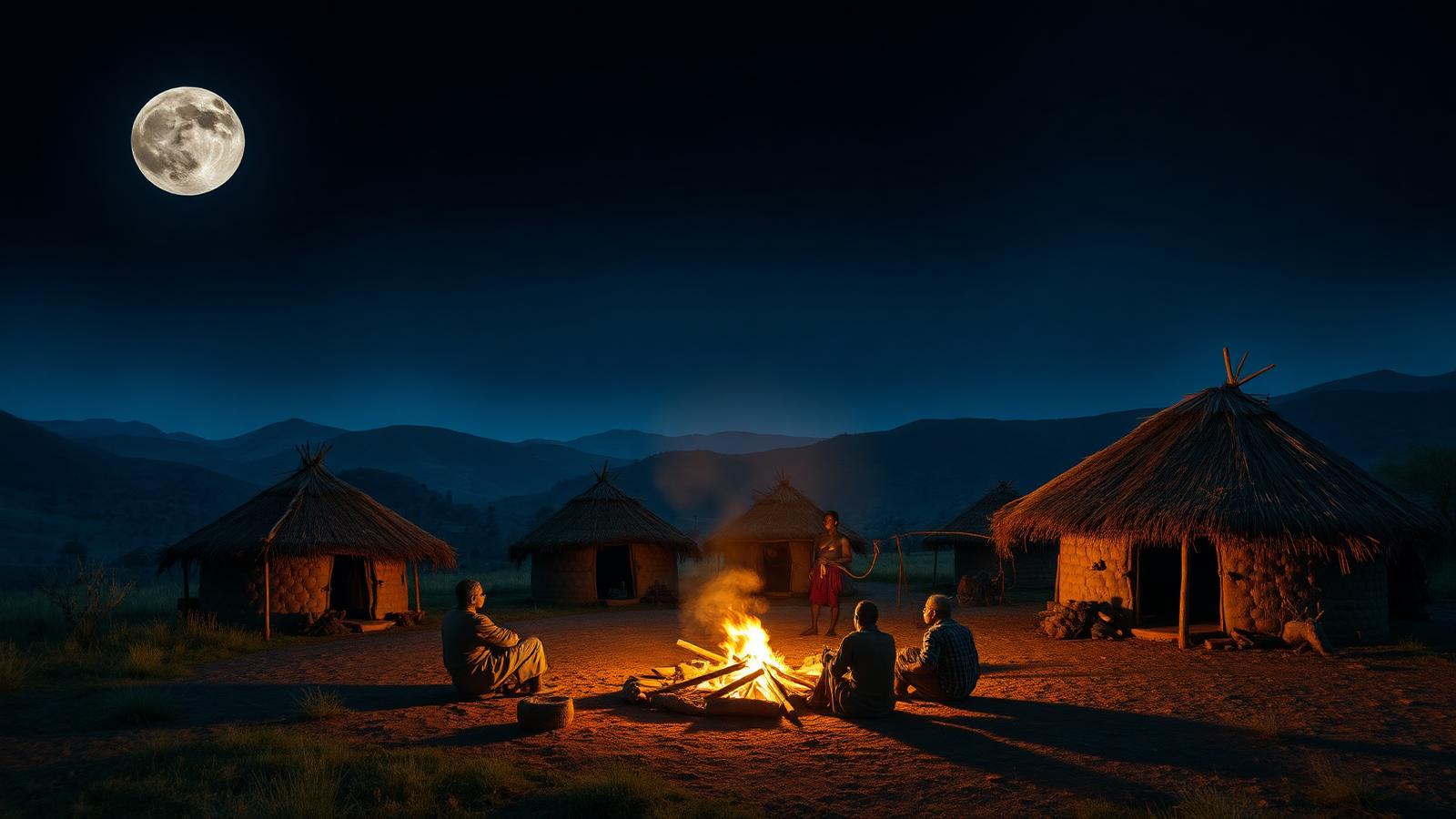
Among the Zulu people, animal parables called izinganekwane were told at night around the fire, and Unogwaja the hare (often softened to 'rabbit' in translation) is one of the great small tricksters of southern African storytelling, cousin to the hare-spirits found from the Kalahari to the Caribbean, where enslaved Africans carried his cunning across the ocean as Br'er Rabbit. Unlike the bullying strong animals — elephant, lion, hippo — the rabbit survives and teaches by wit, patience and the courage to speak plainly when everyone else has gone quiet with fear.
The Moonlight Story
In the season when the grass stood taller than a man and the rivers of KwaZulu ran full and brown, there lived an elephant so enormous that when he walked, the ground remembered his footprints for a full year afterward. His name was Indlovu, and he had grown so used to being the largest creature in the veld that he began to believe largeness itself was a kind of law.
One morning Indlovu gathered every animal at the great flat rock beside the river — the lions came, and the buffalo, and the zebra, and the long-necked giraffe, and even the birds settled in the marula trees to listen. Indlovu planted his enormous feet and raised his trunk high.
"Hear me," he trumpeted. "I am the largest of you. My footprint could swallow ten of the hyena's dens. My shadow could cover the whole cattle kraal. From today, I am king of every creature, great and small, and none shall drink from this river before I have drunk my fill."
The animals shuffled and lowered their eyes. The lion, who might once have argued the point, only flicked his tail and said nothing, for even a lion respects a creature who can crush a tree by leaning on it. The buffalo grunted their agreement rather than be trampled. One by one, every animal at the rock nodded, until only silence remained beneath the marula trees.
Except for a small rustle in the long grass at the very back, where Unogwaja the rabbit sat cleaning his long ears, apparently unbothered.
"Does everyone agree, then?" boomed Indlovu, pleased with himself.
"I have a question," said a small voice.
Every head turned. It was the rabbit, sitting up now on his haunches, his nose twitching in the sun.
"Speak, small one, before I forget you are here," said Indlovu, and a ripple of nervous laughter went through the crowd.
"Great Indlovu," said the rabbit, "you say you are king because you are the largest of us. Tell me — were you always this large?"
Indlovu blinked. "Of course not. I was a calf once, small enough to hide beneath my mother's belly."
"And when you were that small," the rabbit went on, "did the jackal have the right to drink before you, and the tick-bird the right to eat from your skin without asking, simply because they were larger than a baby elephant?"
A few animals began to smile behind their paws. Indlovu's ears flattened slightly.
"That is a different matter," he said.
"Is it?" asked the rabbit. "Or is it only that the rule changes depending on who is largest at the time? If size alone makes the law, then the law is not wisdom — it is simply whoever happens to be biggest today. And what happens, great Indlovu, on the day a creature bigger than you wanders down from the mountains? Will you bow to him gladly, the way you ask us to bow to you now?"
The silence that followed was different from the first silence. It was not the silence of fear. It was the silence of animals thinking, perhaps for the first time in a long while.
Indlovu opened his mouth to trumpet his fury, and then closed it again, because he realized that everyone — the lion, the buffalo, even the smallest dung beetle at his feet — was watching to see what he would say, and no answer he could give would sound like anything but the truth the rabbit had spoken.
"You ask a hard question for such a small mouth," Indlovu said finally.
"My mother told me," said the rabbit, "that a question is not measured by the size of the one who asks it, but by whether it is true. Ubuntu does not ask how large your body is before it lets you sit at the fire. It asks only whether you have brought something worth sharing."
The lion, who had been silent all this time, let out a low sound that might have been a laugh. "The rabbit is right, Indlovu. We followed your size, not your wisdom. But a kraal ruled by fear of the largest body is a kraal waiting to be ruled by whoever grows largest next. Let the river belong to whoever is thirsty, in the order they arrive, as it always has."
Indlovu looked down at the small rabbit for a long moment. Then, slowly, for an elephant does everything slowly, he lowered his great head and stepped back from the water's edge.
"Drink first, small one," he said. "You have earned it more than my size ever did."
And so it was that from that day the animals of that river did not choose their leader by the size of his shadow, but gathered in council beneath the marula trees whenever a hard question needed answering, and it was always the smallest voices that were asked to speak first, because the herd had learned that wisdom does not grow only in large bodies, and that the bravest thing an animal can do is ask, out loud, the question everyone else is too afraid to ask.
To this day, when a Zulu grandmother sees a child stay quiet out of fear of a loud voice in the room, she tells this story, and reminds them: it was the smallest animal at the river who taught the largest one what a king really is.
Moral Lessons
What the Story Teaches
- For children
- You do not need to be big or loud to say something true. Sometimes the smallest voice in the room is the one worth listening to most.
- For adults
- Power that cannot bear a question is not strength — it is fear dressed up in size. Real authority welcomes the challenge that makes it better.
- For leadership
- A leader surrounded only by nodding heads has stopped leading and started ruling by fear. Invite the smallest voice in the room to speak first.
- For business
- The loudest person in the meeting is not always the wisest. Build a culture where junior voices are heard before decisions are sealed.
- For family
- Children often ask the questions adults are too proud to ask themselves. Listen to them before you silence them.
- For community
- Ubuntu teaches that a person is a person through other people — a community that measures worth by size or strength alone will eventually be ruled by fear.
Discussion Questions
For the Family or Classroom
- Why did none of the larger animals question Indlovu before the rabbit did?
- What made the rabbit's question so difficult for the elephant to answer?
- Have you ever been afraid to ask a question because you felt too small or too junior?
- How does the lion's response show a change of heart, not just agreement with the rabbit?
- What does the proverb 'umuntu ngumuntu ngabantu' mean in the context of this story?
- How might this story apply to a classroom, a workplace, or a family council today?
Related Proverbs
"Umuntu ngumuntu ngabantu."
"Ingane encane inolimi olude."
"Izandla ziyagezana."
Characters
Indlovu (Elephant)
Self-declared king
Proud, imposing, ultimately willing to reconsider
Symbolism: Power that mistakes size for wisdom
Unogwaja (Rabbit)
The one who questions
Small, calm, courageous, quietly persistent
Symbolism: The voice of truth that does not need volume to be heard
The Lion
Elder of the herd
Watchful, initially silent, ultimately honest
Symbolism: Authority that recognizes wisdom greater than its own strength
Vocabulary
Indlovu
in-DLOH-voo · Zulu
Elephant
Unogwaja
oo-noh-GWAH-jah · Zulu
Rabbit or hare
Ubuntu
oo-BOON-too · Zulu / Nguni languages
Humanity towards others; the philosophy that a person exists through community
Kraal
krahl · Afrikaans, from Nguni cultural practice
A traditional enclosure for livestock, also a homestead
Watch
Animated story film coming soon.
Listen
Narrated audio coming soon.
Music
McEncomium song adaptation coming soon.
Teacher Resources
For Classrooms and Homes
Download the full parable as a printable PDF — story, cultural background, moral lessons, discussion questions, proverbs, characters, and vocabulary, all in one handout for the classroom or family read-aloud.
Join the conversation
Village Square
Share your thoughts on this parable, ask questions, and connect with others exploring African stories and wisdom.
Village Voices
What villagers say about "The Rabbit and the Elephant"
Loading comments…